
Remigration Policy Platform Review: Danish Past—Danish Future


On October 14th the Danish People’s Party (Dansk Folkeparti), a party which has in the past won as much as 21% of the national vote in Denmark and given support to governments, published a comprehensive remigration plan.
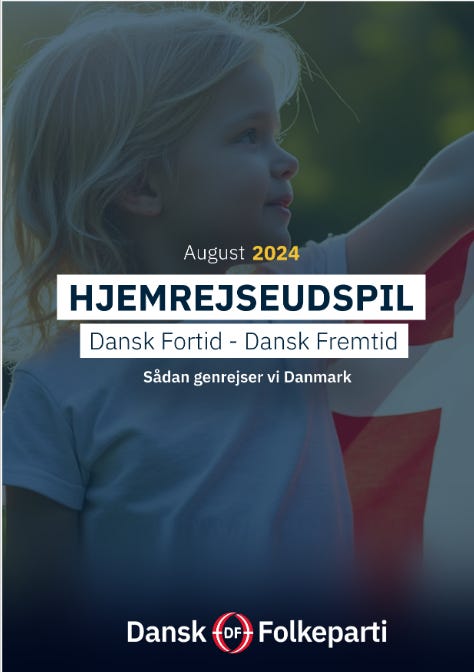
The plan (above) titled Danish Past – Danish Future (Google Translate) [PDF]opens with a strong statement about the current reality in Denmark. In 1980, they state, Denmark was just 1% non-Western while today in 2025 the share of the country with a non-Western background is 10.1%. This percentage is very similar to the 8.7% non-Western share that White Papers calculated in our July 2025 piece titled Demographics and Denmark: An Immigration Model to Replicate?

The difference can be found in the fact that the Danish statistics agency does not count Serbians, Russians, Ukrainians, or Belarussians as Westerners while we do for demographic purposes.
In our aforementioned piece we praised Mette Frederiksen’s government for its explicit preference for Western immigrants and noted that just shy of 70% of immigrants to the country are of Western origin. We saluted her attempts to dissolve migrant ghettos where Danish people can’t and won’t live, parallel societies within their own country.

We admire Frederiksen for being willing to admit that Denmark cannot sustain its way of life if it becomes a non-Western society, but our comments were not all praise.
To quote our own piece:
“As of quarter one of 2025 some 16.3% of the population of Denmark is composed of immigrants and their descendants, an increase of 2.6% since Mette Frederiksen took office. These are not great numbers, Denmark is the homeland of the Danes after all, but once again context can provide a broader view. “
The Danish People’s party provides a reasonable broader view. They state, correctly, that between 1980 and 2020 70% of population growth in Denmark has been non-Western while just 3% has been from native Danes. They point out that the numbers of immigrants from the most culturally alien cultures, Islamic cultures, has increased under Frederiksen by about 2,500 people a year (from 4,500 in 2019 to 7,000 in 2023).
The party is correct in saying that integration of these populations has been a failure and recognizes, in the same way White Papers does, that the gargantuan numbers of immigrants and their descendants makes integration into Western culture simply impossible. These communities have their own institutions, leaders, and cultural systems that make integration undesirable for migrants.
With this in mind the Danish People’s Party makes it first set of policy recommendations:
A comprehensive review of all citizenship grants for the past 20 years to denaturalize criminals
That anyone granted citizenship in the last 8 years be subject to a reconfirmation of that citizenship which will include a Danish language test and a citizenship test.
Revoking the citizenship of any naturalized citizen who has since become a criminal.
Withdrawing from any international convention or obligation that requires Denmark make grants of citizenship to criminals.
These are strong policies that would see the review of 130,000 citizenship applicants granted since the year 2004. Non-Western peoples account for roughly 88,000 of these naturalization, a group that itself accounts for 14.57% of Denmark’s non-Western population of roughly 603,000 people (going by the Danish agency data).
Danish People’s Party does not provide data on how many people they expect these measures could denaturalize, but White Papers is able to put together some preliminary estimates.
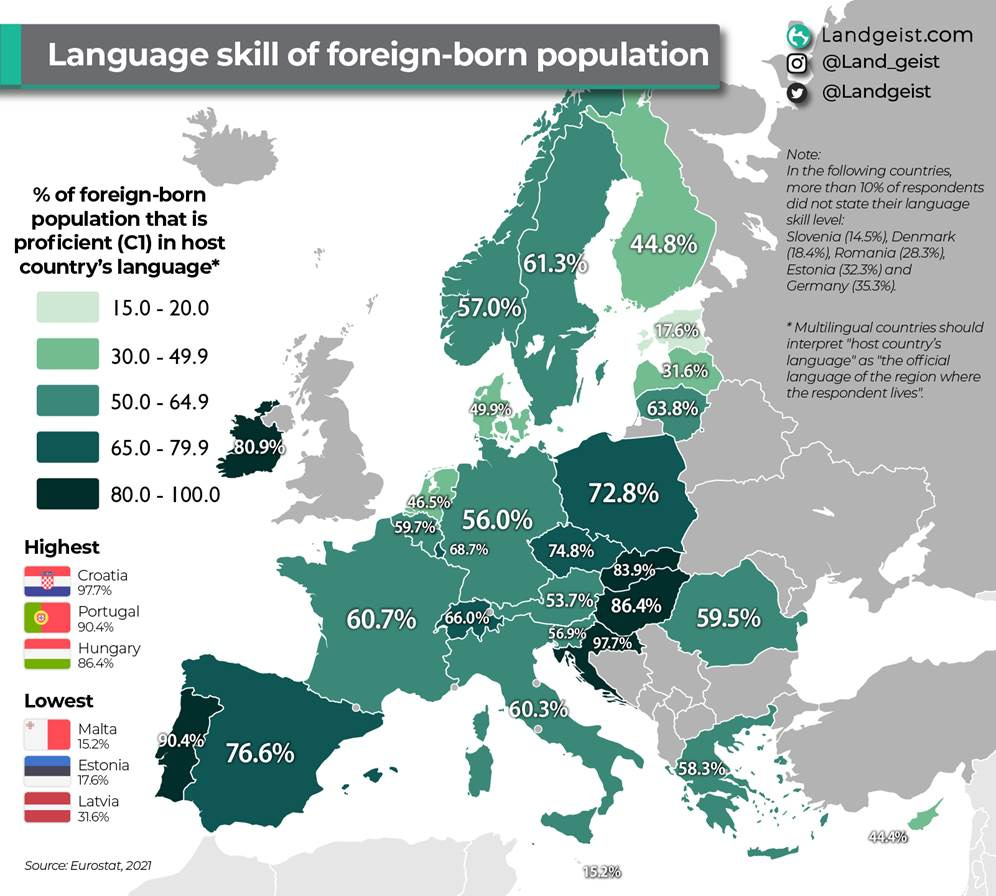
2021 data from Eurostat shows that 4.6% of immigrants in Denmark have no significant Danish language skills while a further 45.5% have only basic or moderate Danish language skills. Assuming that virtually this entire population of immigrants who lack Danish language proficiency were denaturalized under the Danish People’s Party policy then some 44,088 people would be deprived of their Danish passports.
Next we shift onto the party’s promise to denaturalize criminals. Unfortunately the Danish statistic’s agency does not provide data on the nationality of criminals but it does provide their backgrounds. Assuming the party simply denaturalizes and or expels everyone from Denmark of foreign birth who has committed a criminal offense since 2004 then there are 81,077 unique non-Western criminals in Denmark (using Danish conviction data and Berkeley Center recidivism data) who could be expelled. 27% of these individuals, or 21,890, do not have Danish citizenship while the remainder do. If we calculate for the overlap who would also be expelled by way of the language requirements we come up with another 29,652 people who can be stripped of their Danish citizenship and deported.
These calculations bring the total number of potential ‘enforced’ deportees under the Danish People’s Party remigration plan to roughly 95,630 non-Western individuals or about 15.8% of Denmark’s non-Western population, including the 21,890 non-citizen criminals.
The next part of the policy document moves off of the question of remigration and focuses on border control, sending foreigners abroad to serve their criminal sentences. The party wants to close Islamic schools, ban or tax halal products, ban Islamic headscarves in public spaces, ban the Islamic call to prayer, remove state recognition for Islamic religious institutions, and deport all illegal aliens in Denmark. There are no sound estimates of the illegal immigrant population of Denmark though it is estimated to be very low by the Danish government.
Finally, we move onto voluntary remigration—a policy that White Papers has constantly championed. The Danish People’s Party wants to:
Evaluate the current remigration scheme.
Institute a ban on re-entry for anyone who takes up the remigration scheme.
Establish a Ministry of Remigration/Repatriation
These are fantastic policies. The party foresees a Repatriation Ministry that provides logistical support, information campaigns, and oversight of a comprehensive suite of voluntary remigration policies aimed at encouraging non-Western immigrants and their descendants in Denmark to depart for a society that more accurately suites their cultural desires and needs. The party foresees policies to encourage individuals to leave, such as the extant repatriation payment, and policies to push them to leave such as a serious curtailment of any institution and foreign funding that spreads Islamic values in the country.
The Danish People’s Party does not outline exactly what their plan for a voluntary remigration scheme would be, but we have several suggestions.
First, the scheme needs to be well paid. In order to entice immigrants established in Denmark to leave you must pay them enough money to reestablish themselves abroad, luckily this is easily done by turning welfare payments to immigrants into remigration payments.
Currently the non-Western population of Denmark costs the Danish state roughly 31 billion Danish Krone per year, or 4.8 billion US dollars (4.15 billion EUROs). This is the annual cost of this immigrant population after considering the taxes the non-Western population and their descendants pay to the Danish state. The current average income for a non-Western immigrant in Denmark is roughly 336,300 Danish Krone or roughly 52,250 US dollars. Many groups of immigrants such as Somalis, Turks, and Afghans make significantly less than this with some making under 195,000 Danish Krone per year.
If the Danish state moved $3 billion from its welfare budget for non-Westerners and spent that money paying every immigrant (man, woman, and child) $75,000 (483,000 Danish Krone) per head to depart the country then it could afford to pay 40,000 non-Western individuals per year to depart Denmark for other countries better suited to their needs all while saving the Danish taxpayers decades upon decades of future welfare expenses for alien populations and cultures.
The Danish Peoples Party is certainly on the right track with their remigration platform and we look forward to seeing their comprehensive work on the creation of a voluntary remigration scheme such as the one we outlined above.
Support White Papers:
White Papers is a reader-supported publication. To receive new posts and support my work, consider becoming a free or paid subscriber.
Zelle: whitepapersinstitute@protonmail.com
Linktree: https://linktr.ee/wppi
Snail Mail: White Papers Policy, PO Box 192, Hancock, MD 2175
 | A guest post by
|